Tuesday, April 10, 2012

Knee mechanics comparisons

These are some videos that show how implants and synthetics can be important or how they can aid the mechanical function of the human knee.


This is actually a very interesting video of the knee joint which shows the movement of a normal knee that ha snot undergone knee replacement surgery, but is rather a healthy knee.

http://www.youtube.com/watch?v=dq1pHLudtKU

This link contains another video that compares a normal knee's motion to one that has undergone replacement. It shows that there are some variable changes in the mechanical ranges of the implant compared to the actual knee that one has.

Knee Implant Mechanics and Associated Factors


Factors Associated with Knee Replacement:
Patient Weight: Patient weight is highly important for knee replacement because the knee’s are parts that bear the most weight in the body. They are the lower extremities that provide support to the body. Also, they are the ones that spring the body into motion. That is why the knee joints are the fastest to wear out and deteriorate. The amount of activity done with the knee outweighs all other activities with different limbs. Artificial implants should be able to sustain major activity of the knees and they should be able to support the patient for great periods of time.
Shape of the knee: The shape is important because different patients have bones that are calcified at different rates. Also, patients have bone sizes that are different from one another. Thus, the measure matters and the shaping of the artificial implant is important because it serves to offer the patient maximum motion.
Load Transfer: Load transfer is especially important in the knees, because they are highly important in accelerating the person’s movement, thus, there is constant shift of balance on the knees. The spring motion of the knees must have an equalized load transfer. Load transfer also determines how well the patient will be able to do activities such as kneel down, sit, squat, walk, and other vital functions.
Patient Bone quality: The patient bone quality is quite important when considering knee arthroscopy. The patients bones at times can be quite weak. Thus, the joints would not aid the bones at all, but instead make them weaker, so it is important to consider whether there will be a better outcome for the patient through the implants, or whether, there are serious confines to the knee that will lead to harsh results from the procedures taken to put the implants in.
Motion: Motion of the original knee joint should be looked at, but it does not really play into size-up. The new artificial limbs should be able to provide more function than the original joints because the artificial limbs are reinforced and they have the ability to support more than the original joints. The motion of the artificial joints should however match that of the original joints in terms of displacement of the knee during walking and other activities that way there is no problem in such activities in the patient’s future.

Hip Implant mechanics 2


This is a list of other factors that play into mechanics of the patients hip implant

Patient bone quality: Patient bone quality is important because the hip implant is a relatively new part of the body. If the hip implant is able to sustain weight and pressure, there might be a problem with how much the bony mass and muscle of other parts can handle. Often, in geriatric patients, the bony mass may be affected by osteoporosis which is a condition in which there are porous portions of bones that increase risk of breakage. The main bone to look at for quality is the socket of the hip because if it cannot handle the movement of the hip implant, then there is a good chance that it can break or cause immense pain.
Fixation: Fixation has to do with the surgical procedure that involves placement of the hip joint and its alignment with the socket and femur. Fixation is also critical because when the patient is in a neutral position, the hip implant or joint should be aligned in such a way, that there the max pressure should be placed on the hip that specific point. That point is where the body is straightened out. The body should be flush with a flat surface at that point. When the lower extremities are moved, then the hip should release from its neutral position and have less pressure on it. The surgical director must be able to place the hip implant so that it matches such consistencies that the original hip had.
Motion: motion of the original hip implant is important because it mainly involves centripetal force and acceleration. When we lift our leg up, the hip joint spins in a circular motion. When we try to stretch our leg at our side, the hip does not spin, but rather, it lifts like the motion that an oil piston makes. The motion of the implant should be able to match the positions that the original hip made when in different positions.

Hip Implant Mechanics 1


Patient weight: The patient weight is especially important. The hip sustains a certain amount of weight due to the fact that it is part of the lower body, so there is pressure placed against the hip joint. This pressure can often lead to pain in the hip joint upon sitting down or other actions involving purely hip movement. Patient weight should be measured so that the implant can sustain the weight and bear it under body movements.
 Shape: The shape of the hip is similar in patients but not the same. Calcification and other processes can often cause the socket of the hip area to change and alter. Osteoporosis can also have caused the area to weaken, which means that The Hip implant must be shaped accordingly to the patients hip shape. This is critical because there should be less chance of a dislocation or inability to fit the hip implant into the patient’s hip. The shape also affects the motion of the patients hip and that practically initiates movement to the rest of the lower extremities, so shape should be one of the first things to look at when measuring a patient for hip replacement surgery.
Load Transfer: Load transfer goes along the lines of weight, but it also involves the shift of weight from one hip to the other. The load, which we can identify as the body weight of the upper portions of the body (the heaviest parts) obviously shifts from one hip to the other when the patient walks, so there must be an equal load transfer between the hips, which means that THe the hip implant must be able to establish that equal range of transfer.

Sunday, February 12, 2012

Spinal implant Essay format and info


<!· What material is spinal implant made of
o  Cement or other material
o  Fiberglass structure
o  Polymerase bases and cement
<!·         <!--[endif]-->What different parts of the spine have artificial counterparts
<!·         <!--[endif]-->Vertebroplasty
<!--[if !supportLists]-->o   <!--[endif]-->Vertebroplasty is a surgery in which synthetic cement is injected into fractured vertebra. This cement is used to fill up fracture areas so as to relieve pain and to stop the compression of the vertebra due to the loss of coordination with one vertebra.
<!--[if !supportLists]-->o   <!--[endif]-->However, most results have shown that this durgery has proved inaffective. There are certain compications related with
<!--[if !supportLists]-->§  <!--[endif]-->Examples: rigidity, problems with resolving the compression of the vertebra, inability of the cement to create an effect on the fracture
<!--[if !supportLists]-->o   <!--[endif]-->How is this better or worse than complete replacement of the spinal disc?
<!--[if !supportLists]-->o   <!--[endif]-->Is there any proven data showing that this form of surgery is better or worse?
<!--[if !supportLists]-->·         <!--[endif]-->Success rate of spinal  implant
<!--[if !supportLists]-->·         <!--[endif]-->Dangers of spinal implants, could they cause a disruption in flow of neurons and impulses from brain?
<!--[if !supportLists]-->·         <!--[endif]-->Do spinal implants lead to further damage, referred pain, lapse in the nervous system, and other problems?

Knee joint Injuries and Hip injuries which require replacement


·         Knee joint injuries or disease
o   Serious traumatic damage to knee joint due to breakage or paradoxical motion
o   Arthritic conditions can cause articular cartilage to wear out due to massive usage or wearing out due to impact and immense shock absorbance that slowly wears out the cartilage. Aging usually causes the cartilage to wear out. There is a more serious form of arthritis known as Rheumatoid arthritis that leads to destruction of the cartilage. This can be dangerous and requires immediate knee surgery because once the cartilage wears out the two bones that are connected by the knee start to rub against each other causing great pain and inability to move. The knee basically locks into place because there is no gliding motion of the knee as you see in a regular walk. The walk is basically choppy and stiff if the cartilage is not in place.
·         Hip Joint injuries or diseases
o   Severe arthritis can cause deterioration of hip joint
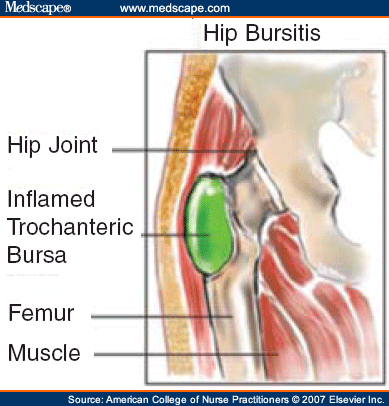
o   Trochanteric bursitis
§  For those of you that don’t know what a trochanter is, it is a bony prominence on the lower side of the hip joint.  The bursa on the other hand is a jelly like sac that covers the trochanter and protects the trochanter’s hard prominence from rubbing against the skin or the underside of the skin. Over time, this bursa can be irritated or start to wear out. This is what is called bursitis. This is painful and is a sign that there is a need for hip replacement because daily activities even the simplest ones such as sitting down or walking can cause severe pain.
o   Herniated hip disk
o   Hip fracture through traumatic incident (i.e. A major fall, collision impact, etc)
§  Any traumatic incident that causes the hip joint to completely break is difficult to fix, especially at greater ages. The broken hip joint will demobilize a person completely unless there is some form of transport. Sitting down will be impossible if this is the condition, thus, immediate surgical replacement is an utmost necessity.
o   Hip joint socket wears out or is fractured
§  If a hip joint is fractured, then a person is practically unable to walk until the fracture heals. The fracture cannot completely heal because there will be an uneven development in the hip and it will cause a loss of balance.


This is an image of trochanteric bursitis. The inflamed point is shown as pointed to and due to its inflammation, it starts to lose the ability to protect the dermis and layers of soft tissue from the hard edges of the bone

Spinal Trauma and Medical problems that lead to increased necessity for Spinal implants


·         Explain several traumatic events that highlight an increased necessity for implanting a artificial body part (mainly joints). Make sure to split the trauma or diseases between the three main artificial parts mentioned in the introduction
·         Spinal injuries/disease/degenerative processes
o   Disk degeneration
§  Disk Degeneration is a process that involves the deterioration of the spinal disk over the period of one’s life. It is a natural process that occurs to everyone but varies with each person according to intake levels of medicine and calcium and other minerals.
o   Ankylosing Spondylitis:
§  Ankylosing Spondylitis is a type of arthritis specifically related to the spine instead of generalized parts of the body. Spondylitis causes swelling of the spaces between the vertebras which are mainly the disks. This can cause immense back pain, stiffness, inability to release the lock that has formed in the back and further complications.
o   Trauma (serious breakage or displacement)
§  Spinal trauma can be caused by various accidents. Spinal trauma can read to broken disks, disturbance to the disks, displacement of disks, and problems on a more grand scale.
o   Stenosis
§  Stenosis is a condition in which your spine starts to narrow which puts great pressure on nerves and your spinal cord causing immense pain and inability to move. This may require surgical replacement of vertebral disks due to the fact that Stenosis has a chance of occurring due to disk problems.
o   Herniation
§  A Herniation is a condition in which a disk slips out of place and stops supporting the spinal column thus hitting a nerve and leading to pain.
                                            Vertebral disk injury or wear out


                                                                This is a picture of a spine that has undergone serious trauma which has     
caused part of the spine to completely break off from the alignment which is avery serious condition.


This is an image of a herniated disk


This is an image of two spines. However, one has been affected by ankylosing spondylitis which calls for immediate replacement surgery due to inability to move the spine.


Introductory elements to the project


·         Explain that there have been major advances in the field of synthetic / artificial  body parts
o   Advances include the different types of replacements that have been created and which ones have proved most successful. For example, the knee joint replacements have two specific widely used types, but both differ because of the material that they are made up off. Thus, which one is most effective, and why? Point out the usage of each and how they have been shown to produce great results in patients who have had replacement surgeries.
o   Explain the ratio’s o failure to successes, this is important because it helps develop the success of synthetics.
·         The 3 major synthetic parts that are artificial spinal implants, artificial knees, and artificial hip joints.
o   These parts are significantly important because they are the precursors to a person’s ability to perform daily functions whenever needed.  If a person needs these replacement because he or she has been disabled due to problems that affect the organs or body parts that are affected by a traumatic event, they he or she should definitely invest in the replacement program because the person will notice that they will be able to do things beyond their normal capacity and they will be able to function normally once again despite the age.
·         Explain why these parts are needed and how they are in mass production and usage today

Monday, November 28, 2011

This is a diagram of the replaced Hip joint and what material is used where in a synthetic hip joint. The diagram shows where polyethlene, cement, and metal are used in a synthetic hip joint.


 These two are diagrams of a Great Hip Joint that is healthy and to the right we have a picture of a hip joint that is worn out and deterriorated. The picture to the right of the worn out hip is a great guide for showing which parts wear out over time and how the artificial hip joint is beneficial. The artificial hip joint is modified so that it takes up the shape of the healthy knee to the left.

Here we see that there is a synthetic knee and a worn out knee. There aer parts of the knee shown in the diagram to the right that show what damage can occur to the knee and what parts are replaced with the artificial knee. The figure to the left showing the artificial knee also shows what material is used to make different parts of the artificial knee.


Friday, November 25, 2011

Synthetic hip joints usage and aid to motion (general info)


Synthetic hip joints consist of two main components. The two components are the ball component and the socket component. The ball component is made of either highly polished and smooth ceramic material or strong and durable metal. The socket component is either made of tough plastic material, ceramic material, or metal based. The material is based on the shape of the bone that can be forms, or the shape that is already created naturally. Also, if both the ball and socket can be placed used within the natural bone, and there is space left to be filled, clinical cement can be used to fill in gaps and strengthen the connection between the bone and the synthetic elements. One of the complications of cement is that it is an inhibitor to the growth of the bone. There is interchangeability between whether the socket is cemented or the ball is cemented.
The synthetic hips can be used to aid motion of the legs itself and placement of weight upon the legs and hips. The swivel motion that allows a person to turn and twist is often inhibited by traumatic injury to the hip joint and can be aided with the use of a synthetic joint. The synthetic joint is very smooth and tough so it will be able to allow for an eased turning motion, and also, It will support the body’s weight distributions. Also, the replacement of the hip joint will allow for a person to get up easily and sit down easily and or rest easily. The synthetic hips will allow the person to exert more power from the hips in activities without creating pain or stiffness.
Also, the hip joint’s ball shape is effective because it allows for a simple motion. Usually, old ball joints are corroded and deterred to a point that there shape Is irregular and cannot move properly causing jams and points where the ball will not move properly. Thus, with the synthetic joint, the will have the ability to move the leg smoothly from one position to another without having moments where the ball gets stuck due to a deformity in the necessary spherical shape.

Components of synthetic knee and how they are replaced


Synthetic knees are created through the use of ceramics. Ceramic is shaped such that it will have maximum resistance to compression and weight; also, it is designed such that it will glide easily from a frontal position to a distal position according to human movement. The ceramic is coated with polyethylene so that t will have resistance to deterioration and chemicals within the body.
Another method involves use of metal components. Metal components are fixed over the bone and then reinforced fully on the bone with polymethylmethacrylate (PMMA) cement. Some procedures do not necessarily require the cement, but it is widely used for longer periods of usage. The patella (lower leg bone) consisting of tibia and fibula are cut according to the shape of the implant. Once the implant is completed, the implant is further connected to the quadriceps muscle and its corresponding femur bone. The catch here is that the new implant does not have to be configured to perform functions. It merely has the ability to glide if the bones are shifted from one position to another. Thus, the implant helps motion and aids the cooperation of both the femur and patella. The implants linings and component create a frictionless movement which aids the motion of the human leg when abducting and adducting (pushing in and out respectively).
The synthetic parts are designed such that they can be split into compartments and singular parts of the synthetic knee can be used for replacement instead of replacing an entire knee. This method is called unicompartmental replacement which is still in its infancy, but it seems to be quite useful. However, for optimum results, it is recommended that the entire knee be replaced so that the synthetic knee can incorporate all of its abilities to form a fully functioning knee.

Thursday, November 24, 2011

Generalized Explanation of why the synthetic parts are needed and how they help


  • ·         Three of the most commonly used synthetic body parts are synthetic spinal disks, synthetic knees, and synthetic hip joints.
  • ·         Synthetic knees are primarily used for the purpose of replacing knees that obstruct ommon functions of the knees and the functions that require the knees to be fully functional.
  • ·         Synthetic knees are necessary whenever osteoarthritis conditions nd cartilage wear out cause deterioration of real knees.
  • ·         Synthetic knees can aid the motion of the leg overall, and they are designed to handle immense weights which usually causes knees to compress and wear out.
  • ·         Synthetic hip joints are highly common in relieving pain caused by arthritis and replacing hip joints that are damaged in traumatic situations or have worn out due to excessive use and reduced levels of cartilage and protection.
  • ·         Synthetic spinal disks are necessary when there are traumatic situations that place pressure on the spine. The spinal disk can go through displacement, be affected by disease, or may be damaged due to trauma.  Injury to the spinal disk can cause problems to movement. Also, the displacement of spinal disks can cause loss of mobility and inability to perform normal every day functions. Injury to the spinal disk may in turn lead to problems with the human nervous system and further body systems.

Topics and Questions to research for development of synthetic body parts


  1. What are the three major synthetic body parts?
  2.  How are these body parts produced? (elements used to construct them)
  3.  Why are these synthetic body parts important? What will they aid
  4.  What is the design of the synthetic part supposed to aid?
  5.  What are the mechanics of the synthetic body parts?
  6.  How are these synthetic body parts connected to the actual bone?
  7.  How do these synthetic body parts last a long time
  8.  How do these synthetic body parts maintain their position on the bone? What safety clips and bolts have been used to keep the synthetic parts latched onto the bone?
  9. What are the main parts of the  real bone that the synthetic body parts help replace
  10.  How do the synthetic body parts and the deteriorated bone compare?
  11.  How are the synthetic body parts designed to allow veins and intramuscular connections pass through?
  12.  Are there chances that these synthetic body parts may wear out and be nonfunctional?
  13. What complications are associated with the synthetic body parts? What dangers and threats can arise due to the synthetic body parts?
  14. What are some goals associated with synthetic parts? What are some body functions that scientists want to be able to generate through synthetic body parts?
  15. How are vertebral disks created, manufactured, developed, what are they made of?